

Designing for Health: Interview with David Berger, MD [Podcast]
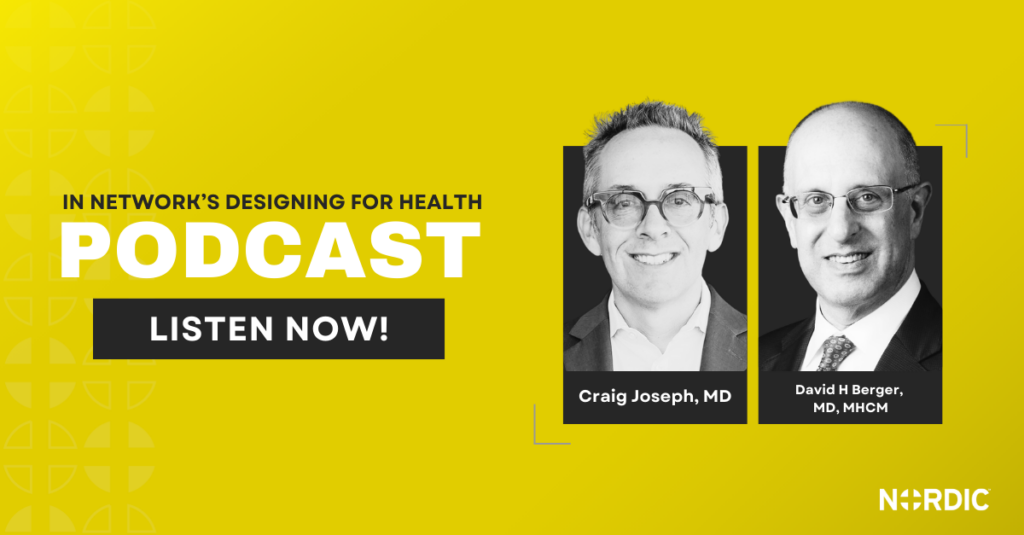
Promoting a healthy workplace culture is one of the key components of any successful health system. However, defining and understanding that culture can be a real challenge, especially in a hospital’s fast-paced environment. A strong workplace culture can have exponentially positive downstream effects, from improving clinician morale to enhancing hospital safety and ultimately improving patient […]
Designing for Health: Interview with Mitesh Patel, MD [Podcast]

Introducing new technology to a health system can be equal parts exciting and terrifying. Freshly implemented tools can often delay workflows, confuse patients and clinicians, and can create inefficiencies. Technology for technology’s sake isn’t enough to deliver and fulfill on the promise of new advancements in healthcare. Human nature tells us that we often default […]
Designing for Health: Interview with Joshua Reischer, MD [Podcast]

Innovation in technology is always advantageous, but without pairing it with thoughtful, human-centered design, it will only remain innovation for innovation’s sake. Understanding user needs through direct observation and empathy is essential, especially when designing for patients less familiar with technology. By focusing on simplicity and usability, organizations can develop solutions that not only meet […]
Designing for Health: Interview with Kit Delgado, MD [Podcast]

In a clinical setting, designing with the user in mind is often an overlooked, yet vital step towards better health outcomes. Using principles of behavioral economics to align the right choice with the easy choice is paramount to ensuring a successful experience for clinicians and patients alike. Deriving insights and experiences from other industries can […]
Designing for Health: Interview with Diana Anderson, MD [Podcast]

Architecture in healthcare plays a pivotal role in shaping patient experiences and outcomes, extending far beyond mere aesthetics. Thoughtfully designed healthcare facilities optimize patient flow, enhance accessibility, and foster healing environments conducive to recovery. This isn’t based on mere conjecture, either; a plethora of peer-reviewed research has shown the significant effect evidence-based design can and […]
Designing for Health: Interview with Farhan Ahmad and Jon Keevil, MD [Podcast]

Emerging technologies have vast, expansive abilities within the healthcare landscape. However, a new asset can be needlessly complex and too overwhelming to gain wide adoption amongst clinicians. In order for wholesale implementation to take place, new software or technologies need to balance increased capabilities with the simplicity and accessibility for use in day-to-day clinical operations. […]
Designing for Health: Interview with Sarah Krüg [Podcast]

In the world of design, a tried and true method of crafting clear communication for a given client is to help the stakeholder stop overthinking things by asking them simple questions: In layman’s terms, what would you want me to know about your product? What do you want to say? How would you describe this […]
Designing for Health: Interview with Josh Liu, MD [Podcast]

The pathway to a great patient experience is filled with potential hurdles, potholes, and unexpected twists. Connecting patients and their data with their multi-pronged care team is an essential task for a modern health system. In this endeavor, thoughtful, human-centered design that keeps both the patient and clinician in mind can lead to positive outcomes […]
Designing for Health: Interview with Susan Snedaker [Podcast]

In the landscape of healthcare technology, understanding user needs and problem solving are paramount. Addressing the pain points of all technology users, from physicians to administrative staff, requires not only technical expertise, but also empathy, curiosity, and patience. By adopting an iterative approach to change management as well as being ready to take feedback and […]
Designing for Health: Interview with Joyce Lee, MD [Podcast]

A course on information technology is not a prerequisite to graduate from medical school, yet so much of a physician’s day-to-day interactions occur in a digital environment. From a doctor’s perspective, understanding the basics of how and why a software program was designed can greatly enhance their experience with the digital tools at their disposal. […]