

Want to improve patient safety? Up your EHR’s usability

Astute readers (for the record, I assume all my readers are astute, thank you very much!) will surely know that I’ve been writing and talking about human-centered design and its application to healthcare for a while now. Even more astute (astuter?) readers will know that my colleague, Jerome Pagani, PhD, and I recently published a […]
Designing for Health: Interview with Tricia Baird, MD

The mission and vision for primary care physicians and other clinical personnel is to leverage data and modern solutions to craft holistic care plans for individual patients. Patient care plans are never black and white. A patient’s ability to pay for necessary medications or whether they have transportation to and from an appointment can make them deviate from a standardized care plan, affecting their outcome. Timely, targeted, and actionable interventions using a care coordination model that leverages whole-person design can help that patient […]
EHRs or social interactions: Can’t we have both?

Everyone knows that every doctor hates their electronic health record (EHR). Have I gone a bit too far with this proposition? Perhaps. How about this: many doctors dislike many aspects of the EHR software that they use every day. That’s probably more accurate. While some physicians might say that the practice of medicine was easier/better/more […]
Designing for Health: Interview with CT Lin, MD, Liz Salmi, and Bryan Steitz, PhD

Conventional wisdom once held that a long wait for test results was acceptable, provided that the results were eventually provided by the primary care physician. That long-held belief is now changing, as emerging research shows that patients want faster results and more transparency. This research, combined with updated federal regulations, is leading to more patient autonomy. Transparency can also free up administrative burden, allowing […]
Shared decision-making: The standard of care we need

Back in the bad old times of medicine (defined by many of us as “before I was practicing medicine”), most physicians were easy to spot. They wore long white coats, had a stethoscope hanging around their neck, and carried a prescription pad in their pocket. Oh, and in the United States, they were virtually all […]
Designing for Health: Interview with Matt Sakumoto, MD [Podcast]

Telehealth and virtual care options increased dramatically during the pandemic and have remained high relative to pre-pandemic levels of use. Undoubtedly a good thing when it comes to efficient and timely care, ensuring that quality and compassion remain consistent between a virtual and in-person experience has become paramount. While it may seem counterintuitive, large language […]
Designing for Health: Interview with Karim Jessa, MD

Much like the syrup that flows from its majestic maple trees, the pace of digital adoption in the Canadian healthcare space has been more gradual than in the U.S. While the push for electronic health records (EHRs) in the U.S. was fueled by the federal government’s enactment of the HITECH Act in 2009, Canadian hospitals […]
Designing for Health: Interview with Dr. A Jay Holmgren [Podcast]

Decades after their introduction, EHR capabilities continue to expand. However, ease and functionality can still be challenging hurdles to overcome. The ‘productivity paradox’ shows that doctors spend quite a bit of time working on something that isn’t actual patient care. Real-world datasets are essential for discovering actionable insights for optimizing the clinical use of applications.
Note bloat, we can’t quit you

Last year, I wrote about how we physicians in the United States write much longer progress notes than our colleagues in every other country. As I noted in that article, this is not just an opinion that I hold but a fact that has been researched and demonstrated. Our notes are up to four times […]
Making Rounds: The hopes and promises of AI [Podcast]
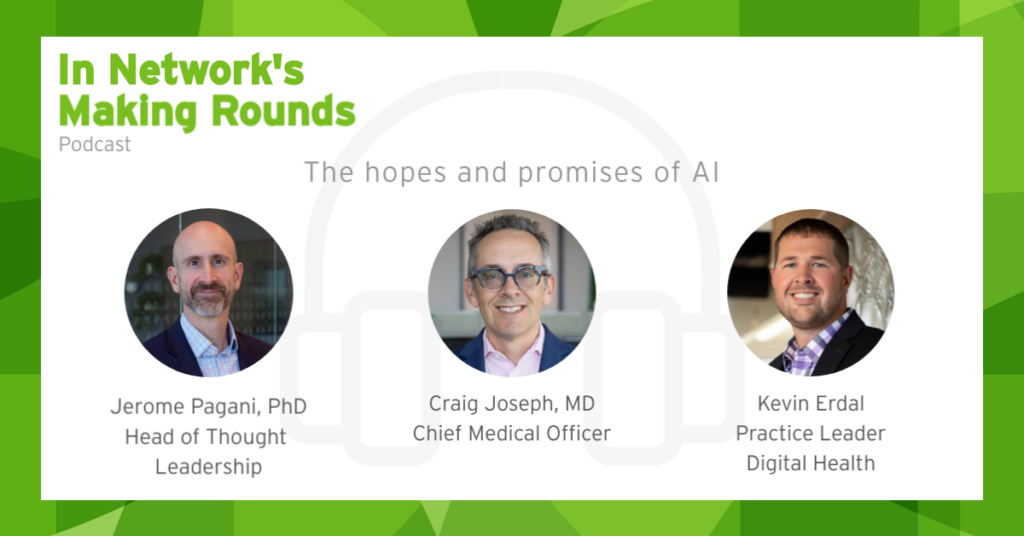
With generative AIs like ChatGPT, Dall-E, and Bard crossing the line into practical utility in recent months, every industry is closely watching to see how what changes AI will bring. Healthcare is no exception. For some, the influx of news promises a revolutionary new way of obtaining and utilizing clinical and operational data. Others are […]