

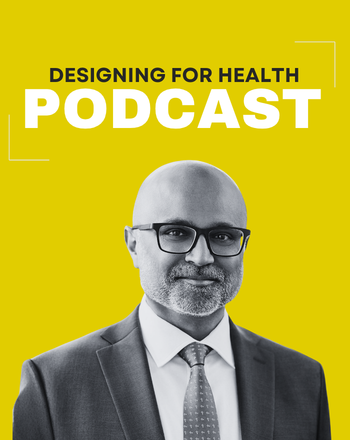
On this episode of Designing for Health, Dr. Craig Joseph is joined by Dr. Bimal Desai, Vice President and Chief Health Informatics Officer at Children’s Hospital of Philadelphia (CHOP). Together, they explore the implications of AI on medical education, clinical decision-making, and the future role of physicians.
The conversation also examines strategies for integrating AI into training, including “commit then compare” learning models, AI-assisted feedback systems, precision education, and even AI-free learning environments. Dr. Desai shares practical examples of how tools like NotebookLM, generative AI, and conversational assistants could transform medical education, simulation training, and clinician development.
The Designing for Health podcast is available on all major platforms including Apple Podcasts, Amazon Music, iHeart, Pandora, Spotify, and more.
Subscribe for updates. If you enjoy the episode, please leave a five-star rating and review.
Want to learn more from Dr. Joseph?
Order a copy of his book, Designing for Health.
SHOW NOTES
- [0:00] Intro
[02:39] From Pediatric Resident to Chief Health Informatics Officer at CHOP
[06:32] “No Struggle, No Mastery”: Why AI Could Change How Physicians Learn
[14:09] Training Clinicians in the AI Era: Commit-Then-Compare, Guardian Angels & Precision Education
[19:18] Deskilling, Never-Skilling, and What Happens When Technology Isn’t There
[27:01] NotebookLM, AI Tutors, and Simulating Difficult Patient Conversations
[31:37] Practicing Difficult Conversations with AI-Powered Clinical Simulations
[41:19] Dr. Desai’s Favorite Well-Designed Thing: The Matador Seg45 Travel Bag
[43:40] Outro
TRANSCRIPT
Intro:
In this episode, I’m joined by Dr. Bimal Desai, Vice President and Chief Health Informatics Officer at Children’s Hospital of Philadelphia, for a thoughtful conversation about one of the most important questions facing healthcare today: If AI can do more of the thinking, how do we ensure clinicians still learn how to think?
We discuss Dr. Desai’s JAMA viewpoint article, No Struggle, No Mastery, and explore the risks of deskilling, overreliance on AI, and what medical education should look like in an era of increasingly capable technology. We also cover practical strategies for training physicians, AI-driven simulation, precision education, and why healthcare leaders should focus on AI that restores clinicians’ connection to patients rather than simply extracting more productivity.
If you’re a healthcare executive, physician leader, educator, or informaticist trying to navigate the AI revolution, this conversation offers both caution and optimism.
Let’s plug in.
Craig Joseph MD, FAAP, FAMIA:
All right, Dr. Bimal Desai, welcome to the podcast. Where do we find you today?
Bimal Desai, MD:
Thanks, Craig. It’s a pleasure to be here today. I am currently actually on the New Jersey shore down in Cape May Point. Working remotely today.
Craig Joseph MD, FAAP, FAMIA:
Excellent. For our listeners, where are you normally working from when you’re in person?
Bimal Desai, MD:
Normally in person. I’m at the Children’s Hospital Philadelphia, right in the University City, West Philadelphia, just west of downtown Philly.
Craig Joseph MD, FAAP, FAMIA:
All right. So a fellow pediatrician, we are the best specialty. I think that we can just put that out there right now. Unless you disagree, you will you agree with that?
Bimal Desai, MD:
Completely agree. I think that we are positively overrepresented in the informatics crowd. I value that a lot.
Craig Joseph MD, FAAP, FAMIA:
Do you have any fear? I agree with you, and I’m wondering if you have any theories as to why that is. I have a theory purely based on absolutely no data, but my own made-up ideas. Why are there so many pediatricians and informatics and cameo IO type roles?
Bimal Desai, MD:
Yeah, I you know, I it occurred to me, and I think you and I may have talked about this in naming a conference, but I don’t have any good theories. I’m curious to hear yours.
Craig Joseph MD, FAAP, FAMIA:
My theory is that pediatricians are excellent at dealing with children. And then, depending on where I’m discussing the rest of the theory, I fill in the blanks. But I think, many of our listeners will know that as a, as a CMO or, or an informatics leader, you’re dealing with other physicians. And, you know, sometimes you have to understand and that, you know, folks have feelings and strong feelings sometimes. And so you have you have to deal with them. I’m not saying that all physicians that dealing with physicians is like dealing with children, but I’m also not saying that.
Bimal Desai, MD:
Yeah. Well, I think one other theory potentially is that pediatricians have to do a lot of subtle, almost code switching. Right? We have to translate things for the parents. We have to translate things for children. We need to translate things to different audiences, to peers. That’s certainly true for other physician audiences, too. But maybe pediatricians have this as their superpower. And so that’s, I think, really useful as an informed assist. Right. You have to take these complex technical topics and figure out how to make them make sense and vice versa.
Craig Joseph MD, FAAP, FAMIA:
I like your theory better. And we’re code switchers and we’re better at it than many other kind of specialties. I’m going to go with that. So tell us, and as I normally do, I will give you credit for the first three times I use it. But after that I’ll just claim it for myself. So how did you get into the role that you’re at now at Chop? Tell us the whole story.
Bimal Desai, MD:
Oh, it’s a it’s a long story, but I have this theory that, quality improvement is the gateway drug to informatics. And almost every informatics I’ve ever met starts because they, they perceive some quality problem or safety problem, and then they eventually realize that the tools and methods we have in informatics are really wonderful way to try to solve those problems.
So for me, I was actually a resident here at Children’s Hospital Philadelphia from 2000 to 2003. And in in my my second and third year residency, I got really involved in what was called what we called the Resident User Group. This was a group of frontline trainees, you know, pediatric residents who would meet like once every quarter with an analyst on our sunrise clinical manager team.
And this was she reached out to us to say, listen, I’m curious to see how the tool is working or not working for you. And she really listened to us and actually we ended up building some amazing, amazingly useful and practical order sets based on our input. And to me, that was sort of this epiphany. I realized that the clinicians were in a very unique position to influence the design of technology, and a lot of early ideas around kind of user centered design, even though I didn’t know that’s what it was called around human factors engineering, even though I didn’t know what that was called.
And I fell into this discipline, and I still remember my first quality improvement project was to try to safeguard the order entry systems against medical errors during the prescription phase. So we actually looked, for example, like all the patterns of errors we were seeing as people were typing, you know, complex medication orders. And we classified them, okay. People were making mental lapses in, in calculating the, the dose or the route or the frequency or the duration or the interval. And then we systematically went back to the order entry screen and said, what can we do to prevent these kinds of errors.
Craig Joseph MD, FAAP, FAMIA:
Sure.
Bimal Desai, MD:
And it completely worked. We showed like a statistically significant reduction in prescribing errors for each of these meds. It was literally my first kind of key informatics project. And then shortly after that, I enrolled in the Informatics master’s program at Oregon Health Science University, fell completely in love with the field, realized I wanted to learn how to make a career out of this, even though this was, you know, this.
You and I have been working this since long before the establishment of clinical informatics as a medical subspecialty. This was in the early 2000. Yeah. And come around to 2013, 2014 with the formalization of the Clinical Informatics Board certification. And, you know, the rest is history. I moved from that role as a literally as a resident in a user group, tinkering with SDM orders to my current role, which is as the Vice President and Chief Health Informatics officer at Chop.
So this current portfolio includes the Clinical Informatics program. I have an amazingly talented and skilled group of provider and dramatists who are both on my leadership team and also within the Clinical Informatics Program. A second team that handles all of our digital health work, including the consults, remote patient monitoring, telemedicine, virtual care, and a third team of professional informatics, all of whom happened to be former clinical.
But they are full time health informatics specialists that basically interface with every single Chop technical project that involves clinical care. So really, really fortunate, that that early experience as a resident led to all this.
Craig Joseph MD, FAAP, FAMIA:
Love it. All right. So it it’s a step, you know kind of a step process where you started small. But now you’ve kind of moved into the big leagues I think that’s great. Let’s pivot to today, which you just nicely brought us into. Let’s talk about and the reason I wanted to have you, at least one of the reasons I wanted to have you on the part is to talk about this article that you co-authored.
It was a Jama viewpoint article with a provocative title. At least I thought, no struggle, no mastery. So what were you what were you kind of talking about? You and your two co-authors talking about. And why is this a problem now?
Bimal Desai, MD:
Yeah, great question. And we were fortunate that this this was sort of a timely topic. My two coauthors are Ron Karen, who’s our chief medical officer, and Dan West, who’s our designated institutional officer, who oversees all of our graduate medical education programs. And, you know, we had been talking about what does it mean as we start to roll out all these AI tools and many of these, we’re not rolling out intentionally.
They’re available to clinicians, things like, you know, open evidence. And the questions that this raised around, what do we need to do as medical educators to adapt to this. And so this idea of no struggle, no mastery really comes from a lot of the learning theories that Dan is very familiar with. And then other areas of concern that Ron and I also understand as practicing clinicians.
The first is that we really need sort of effortful engagement with real clinical problems in order to develop mastery. In other words, if you we did one of the theses that we have is that if you don’t actually work through the problem yourself, you never actually learn it. And I think there’s evidence in, in, you know, the adult learning theory world to back that up, that you have to do the cognitive work to really kind of, incorporate this way of thinking into your mind.
And the second concern that we raised was around, would I bypass experience? And, you know, I, I think of this a lot. You know, we we’ve all taken care of children with asthma, for example. Recognizing asthma is not the hard part. Recognizing when something is not asthma. Right. The child who presents with suspected asthma. But then you you’re like, I don’t know.
Something’s off about the way they’re presenting, the way they look, the way they’re responding or not responding to my therapy. That takes intuition, which is owned by experience in which takes time and actual clinical experience. And so I think that I think there’s a concern that if you just go with what the computer tells you every time, oh, this is asthma and this is that you’re not going to accumulate that experience until it’s too late, right?
You’re not going to hone your instinct for when something does not fit the pattern. And then the third one was around developing metacognitive awareness. So metacognition is literally thinking about how you think. Right. And in the in the realm of diagnostic medicine, we know that humans commit the same types of cognitive biases over and over and over again.
Recall bias, ascertainment bias, value induced bias. Like there’s a million of these things, and it’s just the way that we’re wired our brains commit these forces. And the strongest defense, or one of the strongest defenses against that, is to actually be aware of your own decision making, to say, okay, could I to pause and say, could I be committing a diagnostic error right now?
Right. Am I jumping to this conclusion and committing an ascertainment bias and how would I know if I’m wrong? Right. So developing that instinct to question yourself is actually what distinguishes like good clinicians from really good clinicians. And again, if you consistently fall back on what the AI tells you is the differential diagnosis, do you ever develop that metacognitive awareness?
How do you know that the AI might be hallucinating or that you know that the that the what it’s revealing to you is actually completely incorrect? And so all these things are kind of on our mind, like how does this impact medical education and what do we need to do in response to that?
Craig Joseph MD, FAAP, FAMIA:
It’s super concerning. It was it was it’s been something that I’ve been thinking about because as I get older, these people are taking care of me. Hopefully not pediatricians, but physicians that are going through training in the last, you know, three, five years are going to be taking care of me. And I, I do want them to have that ability to go, something’s wrong here.
This is not typical or exactly to kind of be that expert, to be able to interpret what an AI is, is throwing out there to say that doesn’t seem right, that doesn’t kind of go with what I’m used to saying. It does. This whole conversation reminds me of folks who don’t necessarily see as many kids as pediatricians do, or are not that comfortable with kids.
I, I recall an episode when I, a long time ago when I was practicing full time and I was working at an urgent care, doing some after hours work. And this patient, this patient had already been seen by a family doctor who has to take care of everyone, right? Not just children. But he was very concerned about this child who had either some RSV, bronchiolitis most likely is what it was.
But he thought that the child was probably going to need to be intubated and brought me in, listened to the child, heard very loud wheezing, which was very scary to the to the, the doctor who doesn’t see as many kids. And I was like, well, this is great. I hear a loud wheezing. And this child definitely needs to be hospitalized, but not intubated.
And the difference was I wasn’t, you know, and again, he said, what would make you scared? I’m like, oh, no wheezing, no wheezing would make me scared because then I know we’re not moving air. And this is, this is, I think, what we’re talking about. But just kind of take it and add more technology to it that, well, you know, the AI says that this is right, and it’s been right the last 49 times out of 50.
I’m just going to go with that because I don’t know any better and I haven’t really seen or internalized had that struggle where I had to see these patients without the benefit of some technology.
Bimal Desai, MD:
So and, well, in even that example you gave of when do we when should we, as pediatricians be concerned about the child with severe asthma? Right. It’s when they when their mental status starts to change when you no longer hear air movement, like when the work of breathing is so severe. Right. Like that’s the accumulated experience that we’re talking about. You’ve learned that from seeing hundreds of kids with asthma, right? You didn’t just know it.
Craig Joseph MD, FAAP, FAMIA:
Can’t read it.
Bimal Desai, MD:
That’s right.
Craig Joseph MD, FAAP, FAMIA:
Right. And so certainly there’s this experience. But also. Yeah. And you to the point maybe to try to understand how this works from a technology standpoint, you know, I didn’t have an experienced attending as a resident. I didn’t have an experienced attending with me 24 hours a day or for my 36 hour shift. Right? Like they weren’t looking over my shoulder the entire time.
So I was forced, we all were to, you know, start with a blank piece of paper or an actual piece of paper and kind of write down what we thought was happening. And then that was going to be evaluated by a series of people above us, from our second year resident to our third year resident to the attending.
And, and you got that feedback and that’s how you learn. So what are some things that we can do to I here as you as you pointed out, these are not necessarily tools that your hospital or health care system provides, right? I don’t need your permission. Oh IO or CMO to use some of these tools. I can use them in my phone, on my phone, and in various ways.
And so, so what can we do? What should we be doing? Especially for trainees, for medical students, for residents, for fellows?
Bimal Desai, MD:
Yeah, that’s a great question. And I think in our viewpoint, we suggested a couple of things that educators could try to do. What we don’t have yet is the evidence that this is the best way or the only way to do it. So I’ll share my statements with that one. One of the things, and I actually think this is very practical and easy to do, is this to commit and then compare.
Right? And compare is the idea that you force the learner to say what they think it is, and then you compare it to what the eye tells them it might be. Right. Like think about this in the context of differential diagnosis, where before they go to open up and say what’s the differential for a child with blah blah blah, you ask them, say, well, what do you think it is, right?
Did you go through the do you remember all of this? Remember the vitamins D acronym? You know, is this vascular infectious. You know, toxin traumatic like forcing yourself to go through that exercise categorically and trying to figure out which diagnoses this could be is itself a way of reinforcing your knowledge. So the commit then compare technique I think is really practical.
And it’s not just for differential diagnosis. We talked about this in the context of some of our clinical pathways where we know that pathway driven medicine is higher quality. We know that it reduces variability. We know that you get more appropriate care if you’re following clinical guidelines. And I’ll use the example of like choosing the correct antibiotic for pneumonia.
It’s perfectly reasonable to have an order set that tells the trainee what the first line therapy is for community acquired pneumonia in a child in, you know, in the outpatient setting versus the inpatient setting versus the ICU. No one’s going to question that that’s effective. But what if we also before we showed them the recommendation, we asked them the question, well, what would you what are the two bugs you’re most concerned about?
You know, what is the antibiotic that you might want to pick so that they understand when they click the button and they see, yes, in fact, we’re recommending, you know, Super Celyn or something like that, why we’re recommending it. Right. It’s the it’s the knowledge of not just the conclusion, but the steps that you took to get there.
Craig Joseph MD, FAAP, FAMIA:
Well, that’s. Yeah. And I think that’s the difference between a technician and, and a clinician. Right, right. To be able to think. I’m sorry I interrupted, you’ve gone.
Bimal Desai, MD:
Now, I was going to talk about some of the other strategies, too. So the second strategy we suggested was I as a guardian angel. And so it’s if we could get to the point of sophistication with these tools and, and then I, you know, reasonably it could happen in five, five years. That’s my estimate time horizon where we provide care based on how we’re trained to do it.
But you have this AI system that’s basically able to monitor your work and maybe give you gentle feedback. For example. By the way, you know, the specialist last week recommended you follow up on this low calcium level. And if it was still abnormal to do XYZ, I noticed that it wasn’t collected. Do you want me to add that order?
Right. So to helping you identify gaps in care, I think that would be that would be a very meaningful use of an AI to have it. There is a guardian angel to help you in your work. The third one is that we suggested was to have AI free zones. So areas where the use of AI is strictly prohibited and you’re forced to kind of do it on your own.
And then the fourth one, which I also think is very practical, is precision education. Right? Meaning? And by the way, we’ve demonstrated this works. We had, two informatics trainees a few years ago at Chap who actually showed that you could look at EHR log data and infer what kinds of cases different trainees were seeing. Right. And from that start to build out, okay, you probably while you’re in the emergency department this month, you need to consider seeing more patients of this kind, right?
Because you haven’t seen that diagnosis yet. You’ve not taken care of the child who presents with DKA yet. So be on the lookout for one of those kids. So using AI to help identify gaps in your experience, your exposure, your knowledge, etc. and helping it to have to kind of revise and refine your developmental plan as a learner.
So all these things are kind of theoretical and out there. I would love to see people in the medical education space kind of take this by the horns and, and really kind of mature how we think about training in the AI era.
Craig Joseph MD, FAAP, FAMIA:
Yeah, that’s I mean, especially that last point to me, that’s fascinating. The idea that, hey, you’ve got a month or three months in the emergency department and, and we think you should be a well-rounded physician. We think you need to see these kinds of patients. And you haven’t seen these this category. And once you know, the most obvious is, hey, be on the lookout for a, a patient with DKA.
But another, another one. Just going back to my technology slant would be, hey, we’re not going to randomly assign patients to you. Or you don’t get to take them off the board. We’re going to if we see a patient is coming in who might be diabetic, we’re going to make sure that this trainee gets assigned to that patient, because we know that they haven’t seen that those that that many of those kinds of patients, that’s really something you couldn’t even have thought of a few years ago.
I think that’s, that’s pretty cool. Well, let’s, let’s talk about so we’ve been talking about trainees and that’s great. We should they’re the future. And again I’m selfishly worried about who’s going to take care of me. Let’s talk about attending physicians as well. There’s this concept of de skilling. And I think also in the article you all mentioned mis skilling or the most devious worry never skilling.
So how I’ll throw my one example of de skilling that I think I hear most about, which is gastroenterologist. So gastroenterologists spend a lot of time doing colonoscopies where they are manipulating a tool to look for cancer or potential cancer in the colon. And it’s possible to miss things, that might be very small, or they might have just kind of moved past quickly.
And the majority now of colonoscopies are assisted with an eye that’s constantly looking and, informing the, the physician who’s doing the procedure like, whoa, whoa, whoa, back up, back up two centimeters and look over here because there might have been something there. And this has become commonplace. And there has been I’m aware of at least one study that showed that gastroenterologists that use these tools are at when we remove the tools.
So that’s what they did, is they let you use them for a while and then remove the tool. Also, just going back to just doing a regular colonoscopy without an I kind of overlord looking over your shoulder a better angel to help you. We saw that physicians missed some lesions that they should have paid attention to, and that seems like an excellent example of scaling.
Like you are not as good necessarily as you would have been or used to be when you use some of these technology. So should we be scared by scaling and scaling and never scaling? And if so, what should we? What can we do about it?
Bimal Desai, MD:
You know, that’s a it’s a complicated topic. I will say that I think the, the nature of technology is that we kind of abdicate certain tasks to the technology. Right? People? You know, pediatricians, all of us are probably less facile with, for example, calculating which immunizations the child is due for because a computer makes it for us and it does.
It does it so well. And arguably that’s a skill that we should have retained. And we probably should use the compare technique. Right. Like have the resident trainee prove that they know how to do it and then let the computer take over for them at some point in their, you know, educational development? I think the related question is which of these skills must we retain to be effective clinicians versus which ones are okay to let the computer take over? But they all carry a very specific risk, which is what happens when the technology’s not there.
Craig Joseph MD, FAAP, FAMIA:
Right?
Bimal Desai, MD:
So, even something as trivial as like e-prescribing, which has nothing to do with AI necessarily. We have a generation of medical trainees who have never written a paper order. And so what happens when the computer is not available? I think we now have to train them during downtime. All right. A paper order needs to have these components.
It needs to have a dose, a route, a frequency duration interval, etc.. And you would never have thought 20 years ago that we would need to teach people to do that. Right. So yes, it’s easier. Yes, the prescriptions are faster, more accurate, correctly calculated. We do dose, you know, checking and min minimum and maximum dose checking, drug interaction, checking, drug allergies, all that stuff has been subsumed for you, but it’s also made you specifically vulnerable to when the technology is not there.
And I don’t actually know the right answer. Which of these skills can we give up confidently to the computer? In which ones do we want? Do we need to sort of cling to because it’s actually necessary for us? I can say that, you know, there’s been a lot of attention recently on using AI for differential diagnosis, and the AI tools are getting really, really good at this, in some cases as good, if not better than the human clinician.
And I think we should certainly figure out the best way to use AI tools to help augment our diagnostic decision making. But I would argue that’s not the only skill the clinicians need to do. So this idea that the AI will replace physicians because they can come up with an accurate diagnosis, I think is a little bit inaccurate.
Craig Joseph MD, FAAP, FAMIA:
Yeah, I was going to go with far fetched. Yeah, I totally agree. And I think your point about the technology not being there, you know, is it. Okay. So for instance, is it okay that that doctors nowadays really don’t know how to write a paper or script, you know, newly trained physician, because that almost never will really happen.
And even if you know how to do it, if you haven’t done it in ten years, you don’t have to think about it. You I well, I shouldn’t speak. I won’t speak for you. I, I carried around a little paper, you know, a packet of blank prescriptions, a prescription pad in my pocket for so long. And I think that would come back kind of like riding a bike.
But it’s going to take some time with, you know, specifically thinking about that colonoscopy example. From my perspective, it’s if you’re going to have it’s almost like when would you actually just like realistically now if you use a do a colonoscopy without that eye. Right. It’s if the, if the machine’s broken, it’s broken. But typically if it’s working, you know, you’re going to have that eye.
And so if you do skill a little bit, that sounds to me like that, that just kind of part of of practicing, you know, if what happens when you don’t have the electronic health record and it goes down and we have to revert to writing orders on paper and we have to revert to getting minimal information. We know that the quality goes down, but there’s nothing that one can do about that yet. That doesn’t mean we don’t use electronic health records.
Bimal Desai, MD:
Yeah, I think that’s exactly the right framing, because it it’s this weird kind of dichotomy that we are simultaneously like better off because of the AI in some cases, like diagnostic accuracy, you know, identifying polyps. But we’re also more vulnerable without it. Right. And so and the question is, is that tradeoff worth it or not.
Craig Joseph MD, FAAP, FAMIA:
It’s I’m reminded I’m old but I’m not this old. The of the times at least I’ve read about times before the stethoscope. Right. And physicians would listen to the lungs and the heart by putting their ear up to the patient. And this new technology, the stethoscope was going to and the entire, you know, doctor patient relationship, because now the doctor was a foot, a foot and a half away from the patient.
And that bonding in the same way, maybe you couldn’t hear everything as well. And that turned out okay for us. So I think there are some technologies where the risk of, you know, not having it is, is minor compared to the risk of just saying we’re not going to use technology because there might be a time where we’re going to lose a certain skill.
Bimal Desai, MD:
And most patients probably prefer that to that. We don’t, like, lay our heads on their belly to take a good look.
Craig Joseph MD, FAAP, FAMIA:
Can you imagine? Again, I’m old, but I. I have to say that I. When I went to medical school, we did have stethoscopes. So we were we were moving along as we were preparing for this interview, one of the things saying that you mentioned with AI and and an education was, looking at some of the tools that are just commercially out there and, and wondering how you could use them.
And one of them you mentioned was a notebook. LM notebook. Hello. That’s right. I’m not LM yeah. Which as I understand it, you can kind of and I’ve played around with that a little bit. You can upload files like some PDFs or some documents and then have it create like a podcast or other types of tools where it’s almost as if someone’s explaining to what’s in the documents, and you’re wondering how you can kind of use those either.
Both as a clinician yourself, hey, how do I figure out what’s going on? Or how do I consume this new article or for folks that are in training? Tell us more about that. And have you figured it out and just tell us what the answer is. Really. I just want the answer.
Bimal Desai, MD:
Doctor Desai so, you know, whenever these new tools come across, my first instinct is to sort of play around with them and to say like, is this could this reasonably solve a problem that I’m facing somewhere else? Right. In my personal life, my professional life? And, you know, notebook alum is intriguing. It’s one of this set of tools where you can upload a bunch of documents and it does this sort of, you know, retrieval, augmented generation technique where you can take just those documents and then summarize them and paraphrase them and then things for you.
And Google has added a couple of other features that do sophisticated things, like you read a podcast or an infographic or whatever. And, and they’re, they’re, they’re very clever, you know, and I do think there’s a distinction there between clever and useful. And so, you know, if you want to use this for education, we need to figure out, well, in what circumstances is this truly useful for the educator?
What would it reminded me of, honestly, was I still remember when I was a medical trainee, a job in residency, and at the start of each rotation, the curriculum coordinator would give us, you know, a giant spiral bound notebook of, you know, 50 or 30 PDFs that they wanted us to read. Or they would give it to us digitally on a thumb drive or something that was like this.
This was the curriculum for the pedes endocrine rotation or the GI rotation. And I thought that on the one hand, it was awesome to they’ve given us this content. On the other hand, it was really difficult to ingest that. Right. Like that much that kind of content. So if in the modern era, if I were, you know, the, the, the course director for the medical student rotation in general pediatrics or in some subspecialty, wouldn’t it be interesting if I uploaded all the necessary content to something like notebook alum, and then gave the trainees access to that?
They would have the access to the full text, but they could interact with this in a very different way. You can do things in notebook LM, like create a pop quiz that reinforces the top ten things I need to know about Kawasaki disease. Right. And then they’ll give you a multiple choice question so that you can better prepare for, like the pediatric self exam or the Pete’s board exam, or whatever it is.
So I do think there are ways that we can and should apply some of these novel technologies to improve how we as educators expose the content, and also to give learners a different way to interact with the content. And I think it’s going to be up to this generation of educators and trainees to sort of figure it out.
I can guarantee you that the trainees are using tools like this today, right? They’re coming up with ways even before the AI era. You know, one of my other side interests was for 12 years, I taught the Clinical Informatics Board review course with the American Medical Informatics Association, or Amia. And I remember talking to a lot of trainees or a lot of the physicians who took the course that they had created online flashcards for content, and they had painstakingly, you know, put in all this content to generate these flashcards on specific topics around, you know, HL seven standards or decision support or bio stats or whatever the topics were today.
The language models can do that for you, right? They can create flashcards directly from the clinical practice guidelines or the materials you upload. A close colleague of mine and a member of my team actually did this when he was preparing for his informatics certification. He took all of the materials from, you know, some online training course. He trained his own rag model and technically proficient enough to do this on that content.
And then he generated all of these flashcards or multiple choice questions, basically, you know, to quiz him and to reinforces knowledge like, I think these tools are out there and it’s you know, incumbent upon us to figure out the best ways to use them for trainees. And I don’t think that’s the only one, you know, notebook alum is one of these tools, but I think there’s others out there too.
That could be of use. You know, even ChatGPT has the ability to create custom GPT that you can reinforce with, you know, by uploading specific documents. One of the interesting ideas that I tried when ChatGPT first came out, and one of the features I was very impressed by was it’s sort of natural speech, the conversational AI that it had, and you could get it to actually emote.
You could get it to pretend it was angry or sad or frustrated. You know, it’s one of the more emotive voice agents that I that I’ve tried. And so as a, as just sort of a proof of concept, I was like, well, I wonder if we could do medical simulation with this, right. So could you tell ChatGPT and I’d pay for the $20 a month version?
I’ve named my chat instance. I call her Gigi, so I asked if she and I could have a simulated difficult patient conversation. That was a and we did it as a roleplaying exercise and I said, okay, pretend that you are the mother of a child. On the general pediatrics inpatient unit. Your daughter’s been hospitalized with hip pain and fevers of unknown etiology for the past five days, and pretend that I’m the attending physician who’s taking care of her, and I need to disclose some bad news to you based on the medical imaging results from last night.
In this scenario, when you hear the diagnosis, I need you to react with these emotions. And at the end of this, when I say stop, I want you to critique my performance in delivering this bad news according to this rubric. Right. And I used what I found online was the Vital talks framework with that many of us are familiar with, where they actually say, here’s the five things you should do when you’re breaking bad news to someone, right?
And I was like, on each of these categories, I want you to give me a letter grade, right. And A through F did I succeed at this or do I need help with this specific step? I love it, you know, even in this like completely made up section or simulation, I was blown away by how effective it was.
And this was like sort of, you know, two generations ago with ChatGPT. So I imagine that there are ways that you can do medical simulation with AI. I’m certain that there are ways you could have it reinforce, you know, real life scenarios. Can you imagine these moments before you enter the patient’s room to deliver bad news, simulating it with the AI before you walk in there, like getting your talking points in order, getting your script in order.
So to speak. Right? Like, I do think that this could be a very powerful way to help us actually be more human right to it, reinforce, to make us better clinicians. But it’s, you know, we have to figure out the best ways to do that.
Craig Joseph MD, FAAP, FAMIA:
Yeah. It’s amazing. Simulation was barely used when I was a resident, you know, back in the 1830s. It was a long time ago, Dr. Desai. But now it’s much more common and from very sophisticated, you know, patient I guess dummies is the word where, you know, you press here and they, they emote or tell you that that hurts.
But I love that idea of, hey, all I really need is a phone and some information so that I can anticipate what might happen. Right. And, to be able to do that on one’s own without any, any, you know, significant investment in software, right? It’s just, hey, this is a standard, a standard model that’s out there.
You got to give it something. And I love the idea of, hey, I’m not asking you to tell me how I did out in general. Here’s a rubric, and this is what I want you to grade me on. Did I do these things that the rubric says? I did super, super interesting.
Bimal Desai, MD:
And there’s so many applications of this. You know, it’s not just breaking bad news, it’s giving feedback to peers. You know, if you’re in a medical leadership position, it’s, you know, for example, I’ve seen a couple of people try this out to simulate how would I have this difficult conversation with a peer to give them critique about their performance?
I’ve seen people do this with service recovery right. So if you’re, one of our many staff at Chop who sometimes get called in to speak with families who are having a really tough moment, or they’re angry or they’re upset about something. Service recovery is a skill that you need to reinforce to experience. And what better way to experience it? Well, certainly real life, but the next best way to experience it might be through these AI simulations.
Craig Joseph MD, FAAP, FAMIA:
Yeah. Much easier. And, and, you know, you’re not as fearful of failure as when it’s actually happening. We only have a few more minutes, but I wanted to just get your comment on another Jama viewpoint article. Apparently, other people write them too. Besides, you about. And we picked up on this. You talked about this a little bit about, you know, how I may or probably will not.
And all physicians, you know, it probably still makes sense to go to medical school and, and to become a physician. And there was this, article that kind of talked about, hey, actually, we can use AI not to get rid of physicians, but to take away a bunch of administrative burdens that, we don’t need to kind of excavate out stuff that we’ve had has been assigned to the to physicians that probably are not core to our, our, our being any thoughts on and, you know, is that is that the right way of thinking about some of the AI? How AI can help us?
Bimal Desai, MD:
Yeah. No, I really enjoyed reading this. This was the a it came out shortly after our Jama viewpoint. This one was by Martinelli and colleagues who are have a an affiliation both with a health system in in Italy, but also with Temple University in Philadelphia and the viewpoints called artificial intelligence is not the end of the physician.
And you’re right, they had this graphic that I that really was sort of resonated with me that imagine this is sort of the current state is that, you know, the patient is down here. The patient encounter, you know, is sort of at the, at this foundation and there’s these layers of debris between the patient and the provider who’s trying to take care of them.
Right. And the debris includes the documentation burden and the billing and medical coding. You know, overlay and prior authorization and arguing with insurance companies and then all the other things that kind of interfere with that direct relationship. And in this graphic, they imagine and they use the exact word excavation. They imagine that AI is the tool that will help us dig out from that debris.
So that’s the distance between you and your patient is actually collapsed down to zero, right. In that the next vision of this is that you that the role of physicians changes to be one where presence is restored and that it’s the physician who’s governing the use of AI in their own clinical practice. So what I liked about this was I’d also been thinking about how do we know if an AI tool is actually good for us as a, as a medical specialty or as a field, or if it’s bad for us?
And I had started to think about this idea of AI that is meant to be extractive, meaning it’s designed to try to extract more work from the human. Almost like a strip mine where you just trying to get more and more productivity out of the same workforce versus restorative, which is exactly what they describe in this Martinelli viewpoint.
Right. Which meant to restore presence, to restore what it means to be a physician. And this framing like, is this is this actually a good idea from an AI standpoint? Just because you can doesn’t mean you should. Is this extractive or restorative? Is is this consistent with our philosophy? You know, our sort of moral and ethical grounding as clinicians and therefore a tool we want to promote?
And I actually think this is the reason why some of our early successes in AI, in clinical practice have resonated to the degree they have. Ambient scribes are completely restorative, right? They, you know, no one has ever shown that they actually increase productivity. Sure. Right. They’ve been a couple of high quality studies now that show they it’s not clear if they have any financial ROI, nor are they designed to do that.
In my opinion, they’re purely restorative. They’re meant to collapse that distance between me and my patients so that I’m not turning my back to them and typing on a keyboard. I’m actually interacting with them directly. And so I, I’m, I love that idea. I love the idea that we should be, as a medical field, on the lookout for specifically restorative solutions.
Right? Because there’s a lot of things wrong with health care. And if we can sort of decree it right, six prior or six documentation. Six you know, all the things that interfere, it might actually be better, right? So the last line in this Martinelli paper is that AI is not the end of the physician. It’s the return of every reason to be one, and I love that. I absolutely love that. So and was grateful to them for really highlighting this opportunity.
Craig Joseph MD, FAAP, FAMIA:
Yeah. And I’m, I’m thankful that you brought it up and that we were able to discuss it. I, I looked at that graphic and kind of digging out from all of the administrative burden that, you know, you really didn’t need to go to medical school to do, but has been, you know, put on top of physicians, for so long that now we just think of it as part of our job, even though it probably wasn’t part of our job 20 years ago.
And that this, this concept is, is very appealing. All right. I would love to continue this conversation for, a few hours more, but unfortunately, we’re out of time. I do want to ask you the question, though, that we always end with on this podcast, which is, is there something in life that is so well-designed that it brings you joy whenever you interact with it? So what do you think?
Bimal Desai, MD:
So this was an easy one, because every single time I use this, I actually turn to my wife and I’ll say, man, I love this thing. So am I. And it’s because it’s so well designed. So I, I’m always on the lookout for like the perfect travel bag, right? The one bag. I’m the one bag traveler. I carry like a single 45 liter duffel bag when I, when I go on business trips or, and even like week long trips.
And so finding the right bag to me was always like a super important goal. There’s a company out of Boulder, Colorado called Matador, and they make this bag. It’s called the segue 45. Segue in the bag is short for segment. So imagine it’s in. The design of it is so wild as far as Duffel Bag, you might think, like, how can you make a duffel bag better? So I love the idea of packing cubes, but I hate packing cubes and what this does.
Imagine you had a six liter, a nine liter, a 15 liter, another nine liter, and another six liter packing cube all stitched together in a long duffel bag. So it’s like a duffel bag that’s made up of packing cubes. But it also has like a main compartment underneath it. So as you’re packing cubes empty, you can just shove all your dirty laundry underneath.
It is I love it. I just love the design of it. Plus it’s got hidden backpack straps. Plus it’s got a hidden waist strap. Plus it’s got like, you know, you know, a laptop storage compartment. I just I love this bag. I love everything about it. And it’s my favorite travel bag by far. So well-designed.
Craig Joseph MD, FAAP, FAMIA:
All right. Well we will definitely find a link to that. And put that in the show notes I look, I’ve not heard of this so I look forward to kind of looking at it. It’s it is awesome when you find a product that clearly someone or a bunch of people have thought a lot about how to make that product the best it can be.
Craig Joseph MD, FAAP, FAMIA:
And you found one. So maybe I will I’ll have to go out and see if these things work for us. Well, this has been a pleasure. Thank you so much. I really appreciate your time and educating, all of us on how I can be helpful both to physicians and training and, but also to some of us who have been out for a little bit and, and look forward to ongoing scholarship from you and from your colleagues at Chop about how we leverage technology to improve health care that that we give and also to help us provide that health care to others.
Bimal Desai, MD:
Yeah. Well, thank you, Craig, for the podcast and for hosting me today. This was a great discussion. I always love catching up with you and I hope we can do it more.
Craig Joseph MD, FAAP, FAMIA:
Awesome. Thanks again.
Outro:
Thanks for tuning in. We hope you enjoyed today’s episode. For more on Dr. Bimal Desai follow him on LinkedIn. And don’t forget to look at the show notes for links to the articles we discussed and to Dr. Desai’s design choice, the Matador SEG45 Travel pack.
Check back for more episodes of Designing for Health wherever you listen to podcasts or on NordicGlobal.com. We’ll see you again next time on Designing for Health.
LinkedIn and other web links:
Bimal Desai LinkedIn
https://www.linkedin.com/in/bimaldesai/
Promoting Clinical Expertise in the Age of AI: No Struggle, No Mastery
https://jamanetwork.com/journals/jama/fullarticle/2848742
Artificial Intelligence Is Not the End of the Physician
https://jamanetwork.com/journals/jama/fullarticle/2848376
Matador SEG45 Travel Pack