


Freeing CIOs to focus on strategic priorities amid cost pressure
Healthcare chief information officers (CIOs) aren’t short on data, but many are struggling to use it. Fragmented systems and limited interoperability continue to consume time and attention, leaving IT teams focused on “keeping the lights on” instead of forward progress.
As leaders pursue strategic initiatives like AI, advanced analytics, and smarter decision‑making, foundational issues, like how EHR work is supported, governed, and sustained, often stand in the way.
To understand how CIOs navigate this tension, Nordic analyzed a 2026 survey of healthcare CIOs and IT leaders who use Epic Application Managed Services (AMS).* The findings show CIOs are increasingly using AMS not just to manage workload, but to reduce fragmentation, restore clarity, and create the capacity needed to focus on work that adds the highest value.
What the data shows about Epic environments today
Epic environments are becoming more complex. As work scales, the real risk isn’t just cost overruns, it’s losing visibility into how work is actually being done.
As health systems modernize their technology investments, integrate new data sources, and pursue AI, the challenge isn’t access to data. It’s keeping that data reliable, governed, and usable once systems are live.
This is where CIOs are reevaluating AMS, not as IT support coverage, but as the operating layer that protects stability, drives performance, and increases people capacity over time.
In fact, the research reveals 61% of healthcare IT leaders say outsourced managed services are now a central part of their IT strategy rather than a supplemental one.
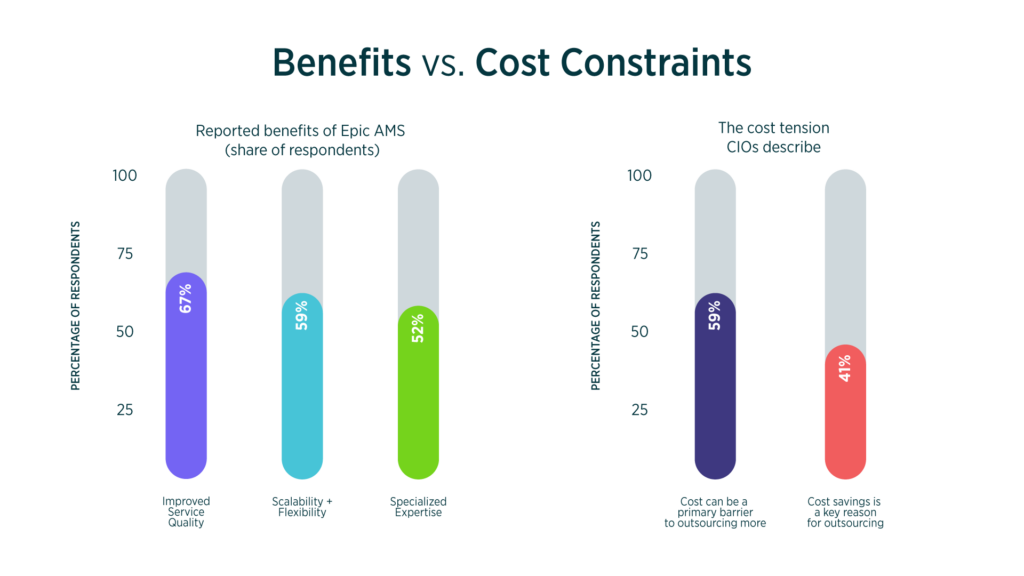
Survey respondents report clear benefits from Epic AMS, including improved service quality, scalability, and access to specialized expertise. Yet cost remains a key constraint: Nearly six in 10 CIOs say cost can be a primary barrier to expanding support, even as many cite cost savings as a reason they outsourced. This tension reflects how CIOs are balancing operational gains with financial discipline.
What this means for CIOs
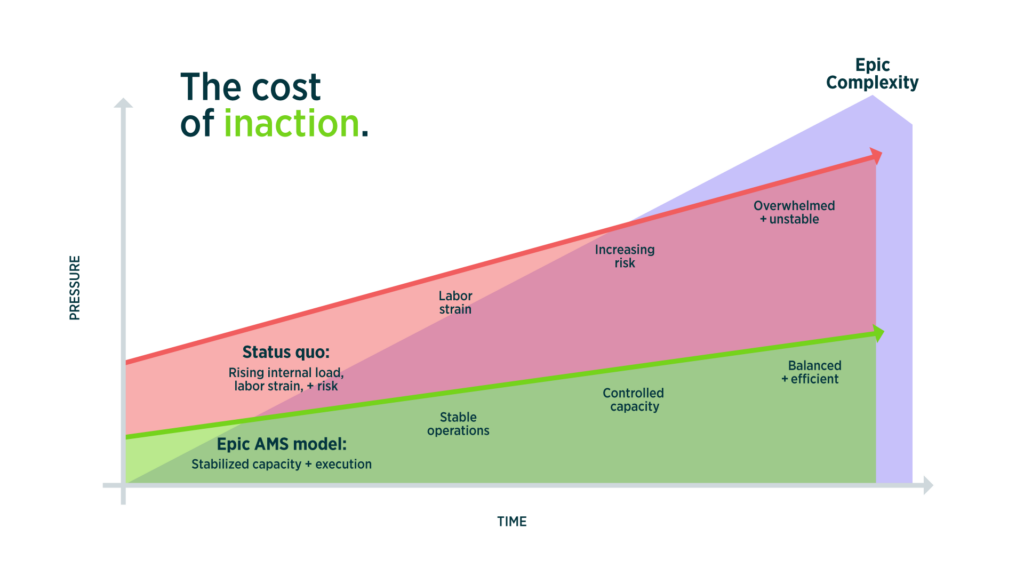
Inaction now carries its own risk. As Epic environments grow more complex, maintaining the status quo makes it harder to consistently understand workload, performance, and cost drivers. Without clearer ownership and structure, CIOs are left managing rising pressure with incomplete information, making tradeoffs harder to explain, decisions harder to defend, and planning less predictable at the executive level.
For many organizations, AMS is moving from a supplemental service to a core operating component, not just to reduce effort, but to restore clarity, predictability, and control.
How CIOs are rethinking the role of Epic AMS
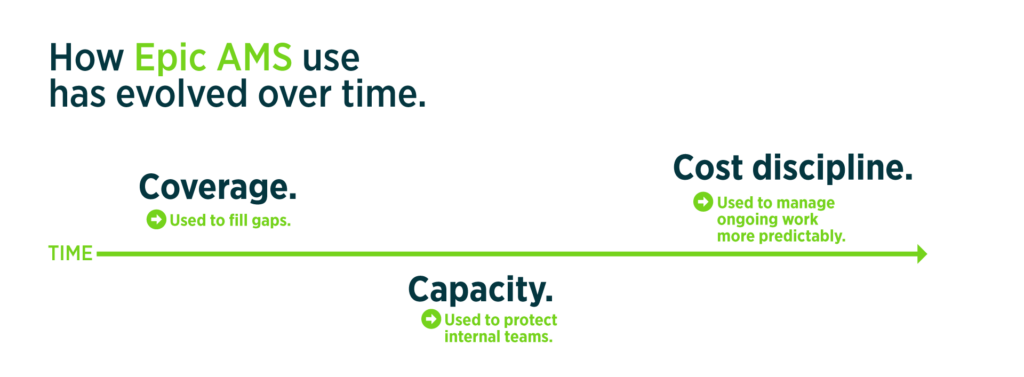
Historically, organizations adopted AMS to solve coverage gaps and staffing challenges. Survey responses suggest that is changing: CIOs increasingly view AMS as part of how Epic work is owned, governed, and sustained day-to-day, not just extra help when teams are stretched thin.
That shift aligns with how leaders describe IT’s role overall. In the survey:
- 51% of respondents say IT is crucial and aligned with strategic goals.
- 31% say IT is operationally important.
- Only 16% still view IT primarily as a support function.
When AMS is treated as part of the operating model, the conversation changes. Instead of focusing only on hourly rates, CIOs evaluate how work is distributed, how predictable execution is, and whether the model supports long-term cost discipline without introducing new risk.
What this means for CIOs
As Epic complexity grows, AMS decisions are becoming less tactical and more structural. CIOs are no longer evaluating AMS based solely on coverage or cost, but on whether the model can scale predictably with clear accountability and measurable outcomes as reliance increases.
Where CIOs are seeing real impact
As CIOs rethink Epic AMS as part of the operating model, the survey shows clear operational impact, particularly in areas that directly affect cost, capacity, and performance.
On the IT side, respondents report reduced workload and faster problem‑solving after outsourcing Epic support. On the clinical side, many report less administrative burden for clinicians. While CIOs may be cautious about labeling these outcomes as direct cost savings, they reduce internal effort, limit escalation, and protect capacity in some of the most resource‑intensive parts of the organization.
In practice, this means fewer hours spent on routine support, less time lost to delays or rework, and more predictable execution across teams. These changes don’t always appear as a single budget line item, but they have real financial impact by freeing up internal staff and reducing operational friction.
Operational benefits
- 72% report reduced IT workload after outsourcing Epic support.
- 70% report reduced administrative burden for clinicians.
Fewer hours spent on support, fewer escalations, and less clinician time lost to administrative work all translate into real financial impact.
What this means for CIOs
For many organizations, the value of Epic AMS shows up first in time, capacity, and consistency, but the longer-term impact is visibility. As execution becomes more standardized and accountable, CIOs gain cleaner operational data they can actually use to guide decisions, manage performance, and justify investment.
Why CIOs remain cautious about expanding Epic AMS
Even as healthcare leaders report operational benefits from Epic AMS, the survey shows clear limits on how far they are willing to expand it. Cost is the most frequently cited constraint, with 59% of respondents saying it can be a primary barrier to outsourcing more Epic AMS support. But cost is not the only factor shaping adoption decisions:
Concerns about control and confidence also play a significant role. More than half (51%) prefer to keep work in‑house, while 44% cite security or compliance concerns. These responses suggest that hesitation is less about whether AMS delivers value, and more about how risk, accountability, and oversight scale as reliance increases.
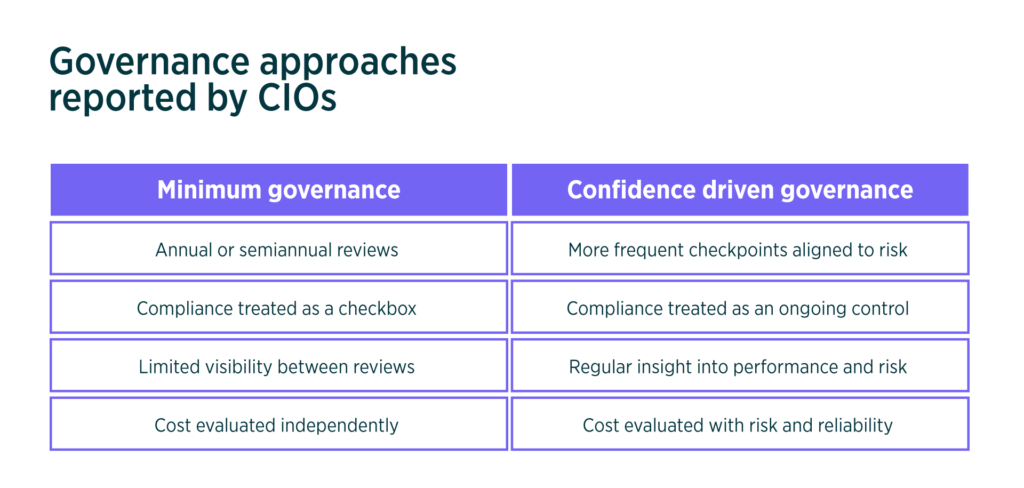
Governance practices reinforce this tension. In the survey, 77% of respondents said they play a leading role in Epic AMS decisions, reflecting how closely managed services are tied to executive-level oversight once embedded in daily operations. As reliance on AMS grows, governance challenges tend to surface not when support breaks down, but when decision ownership, prioritization, and escalation paths are inconsistently defined. Without clear governance, confidence erodes not because of a system failure, but because accountability is harder to see.
What this means for CIOs
CIOs want cost relief, but not at the expense of control, confidence, or risk visibility. Efficiency without confidence slows adoption. Concerns around control, and communication often determine how far AMS can expand, regardless of cost pressure or demonstrated operational benefit.
The emerging expectation for Epic AMS
As cost pressure grows, expectations of AMS are evolving. CIOs are no longer satisfied with reduced workload alone; they want clearer proof of value and risk management.
The survey shows that:
- 46% of organizations measure IT impact using a balance of cost savings and customer satisfaction.
- 18% measure IT impact primarily through cost‑saving metrics.
- Only 3% say IT impact is not formally measured at all.
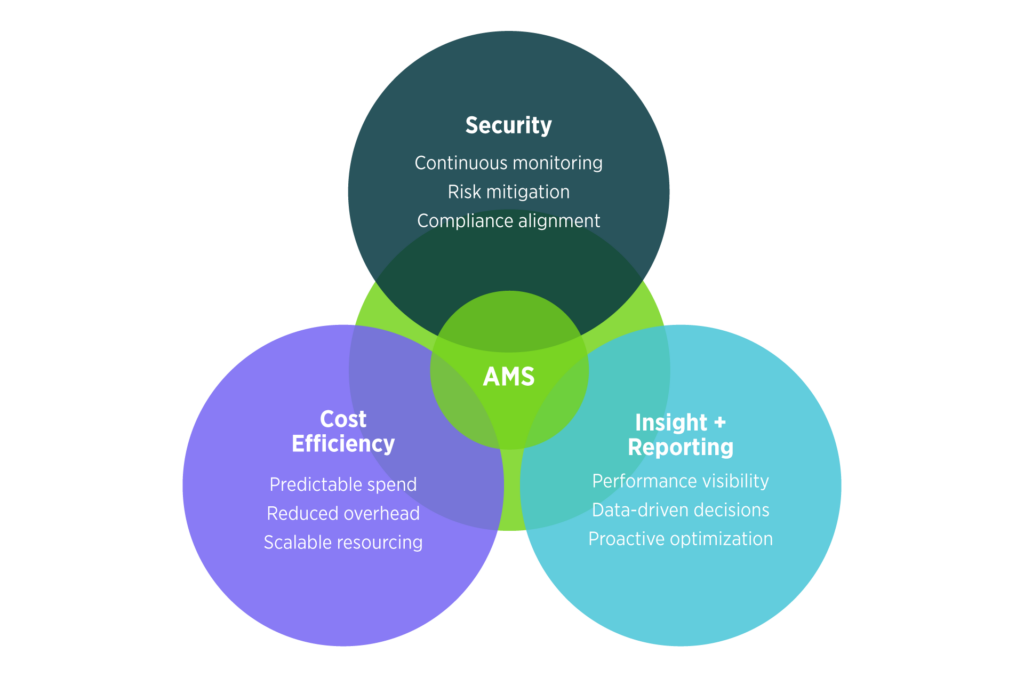
At the same time, respondents explicitly rank reducing overall costs as a future Epic AMS priority, alongside security, workflow optimization, and increasingly, analytics and reporting capabilities.
This signals a shift toward AMS models that pair cost efficiency with greater transparency, insight, and assurance.
What this means for CIOs
Visibility is increasingly what determines confidence, scalability, and the long‑term defensibility of the AMS model.
What CIOs should be asking now
Is Your Epic AMS model built for today’s cost and risk environment?
As Epic AMS becomes a permanent part of the IT operating model, the question for CIOs is no longer whether to use AMS, but whether their model is structured to deliver measurable value without introducing new risk.
Leading organizations are stepping back to reassess AMS readiness against their own cost pressures, risk tolerance, and operational priorities, asking questions like:
- Where are we still paying for avoidable inefficiency?
- What workload should AMS absorb that it doesn’t today?
- How do we validate cost impact without increasing risk?
- How consistently can we see, and trust, data on workload, performance, and cost impact across AMS and internal teams?
These questions tend to surface the same core focus areas:
- Cost discipline: Do we understand where AMS is actually influencing cost?
- Capacity optimization: Is AMS protecting internal capacity where it matters most?
- Risk and governance: Does our governance model match the level of reliance we place on AMS?
- Transparency and reporting: Do we have consistent, decision‑grade data to validate cost, performance, and outcomes over time?
These are no longer hypothetical questions. They reflect a market where CIOs increasingly judge AMS not just on coverage, but on its ability to support sustained cost control, operational resilience, and confident, data‑backed decision‑making.
What this means for CIOs
The conversation has shifted from “Should we use AMS?” to “Can we defend how it works and prove it’s delivering value we trust?”
As Epic AMS becomes a permanent part of the IT operating model, structure and governance are only part of the equation. The most difficult, and least discussed, dimension of these decisions is what AMS means for the people who support Epic every day.
That’s where “Leading the AMS Transition: A Guide for the Hardest Part“ helps.
This leadership guide is designed for CIOs and IT leaders who recognize that AMS decisions are no longer purely operational. The playbook addresses the questions that often stall progress or surface too late in the process:
- What actually happens to teams during an AMS transition?
- How do leaders communicate change without creating fear or backlash?
- How do you balance cost discipline and operational confidence with responsibility for your people?
- What can you expect from an AMS partner?
Rather than focusing on economics alone, the guide helps leaders navigate the human realities of AMS, protecting trust, setting clear expectations, and leading transitions responsibly as support models evolve.
For CIOs, it provides a practical framework for making AMS decisions they can explain, defend, and stand behind not just operationally, but as leaders.