

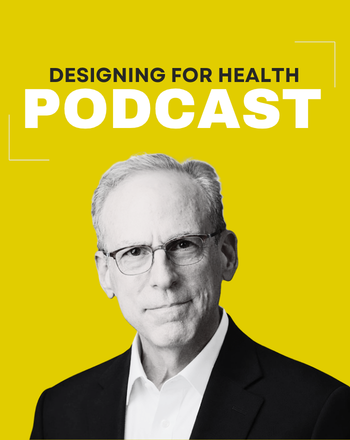
In this episode, Craig Joseph sits down with Robert Slepin, Chief Digital Officer at SE Health, to explore lessons learned from a decades-long healthcare leadership career spanning vendor organizations, provider systems, academic medical centers, and international healthcare environments. Drawing on experience as a CDO, program leader, and advisor, Robert shares practical insights on navigating complex healthcare transformations, building resilient teams, and creating clarity in large organizations.
The conversation examines why major healthcare projects rarely unfold exactly as planned, how continuous learning and adaptation are essential to successful transformation, and why clarity remains one of the most important and challenging leadership skills. Robert also discusses SE Health’s approach to artificial intelligence, including governance, ethical frameworks, use case prioritization, and balancing innovation with safety.
The Designing for Health podcast is available on all major platforms including Apple Podcasts, Amazon Music, iHeart, Pandora, Spotify, and more.
Search for “In Network” and subscribe for updates. If you enjoy the episode, please leave a five-star rating and review.
Want to learn more from Dr. Joseph?
Order a copy of his book, Designing for Health.
SHOW NOTES
[00:00] Intros
[03:54] Inside SE Health’s Mission and Digital Transformation Strategy
[05:45] Why Major Healthcare Projects Never Go Exactly as Planned
[07:23] A High-Stakes ERP Implementation and the Power of Adaptability
[10:39] Lean Thinking, PDSA Cycles, and Building Resilient Project Teams
[15:20] Clarity as a Leadership Superpower
[19:19] SE Health’s AI Strategy, Governance, and Future of Healthcare Technology
[23:38] Integrating AI Governance into Healthcare Operations
[31:03] Will AI Replace the EHR?
[36:15] Robert’s Favorite Well-Designed Thing: His Laptop Setup
[38:15] Outros
TRANSCRIPT
Intro:
Today I’m joined by Robert Slepin, a healthcare technology executive whose career has spanned vendor organizations, health systems, digital transformation leadership, and now the Chief Digital Officer role at a major Canadian home and community care organization.
In this episode, we explore why large healthcare transformation projects rarely unfold exactly as planned, and why that’s not necessarily a problem. Robert shares practical lessons on adaptability, continuous learning, governance, and the importance of defining what “good” looks like before launching major initiatives.
We also dive into AI strategy, including how healthcare organizations can balance innovation with responsible governance, manage the flood of AI use cases, and prepare for a future where electronic health records may look very different than they do today.
If you’re a healthcare leader trying to navigate digital transformation without succumbing to either hype or despair, this conversation is for you.
Let’s plug in.
Craig Joseph MD, FAAP, FAMIA:
Robert Slepin. Welcome to the podcast. How are you this fine day?
Robert Slepin:
Great Craig, thank you so much for hosting me.
Craig Joseph MD, FAAP, FAMIA:
I am excited to have you. You have a I know you were denying that this, before we started recording, that you have had a long and storied career. I think you said maybe it’s long, but it’s not that storied. I think it’s story. So why don’t you, instead of me trying to summarize it, why don’t you kind of tell us about your career? Maybe start in third grade?
Robert Slepin:
Yeah, I was going to start in seventh grade, because that way it’s. We’ve only got about 30 minutes, and I don’t want to go over the limit, Craig. But, seriously, it is a long career. And I suppose you’re right, because I do have a lot of stories to tell. So if that’s the definition of story, but seriously, I’ve been really lucky to be in health care.
I do for most of my career. I started on the vendor side, actually working for a hospital information systems company. It was called Management Systems Associates, or MSA. I worked there for five years in a variety of roles. Incredible company that eventually was by all scripts, and became part of that, journey. But they’ve been in business for a few decades and have provided all our systems to small and mid-sized hospitals in the States.
It was a really wonderful learning opportunity. And while I was there, I interacted with many data processing and Mis directors is what they were called or information systems directors in hospitals. And I just really loved their job and their work. And I had a passion for being on the provider side. So I was lucky enough to get an opportunity and pivoted my career to a health the healthcare CIO side for about 20 years.
And after doing that for a couple of decades, I decided to pivot again when I was CIO for an integrated delivery network that was acquired by, a larger, neighboring network. I did some soul searching and decided, you know what? This is a lot of fun. I think I’m going to focus on transformation program leadership. So, I was lucky enough to get a job, as a program director and did that kind of work program leadership and advisory work, or mostly clinical, but also business transformation projects for the next ten years.
And then about a year and a half ago, I pivoted back into the CDO chair here at SE Health. It’s, it’s been a lot of fun. I’ve worked in integrated delivery network, academic medical center environments, population health management, disease management and payer settings. I’ve had international experience in the U.S. Middle East, and for the past nine years in Canada, I’ve worked with, Johns Hopkins Medicine.
During National Stanford Health Center, health, University Health Network, and the hospital for Sick Children in Toronto, Alberta Health Services, and more. For the last eight years, I’ve been doing board advisory roles as part of my work, and AC health was a client of mine and an opportunity came up and about a year and a half ago for the chief digital officer role, and I came on board.
Craig Joseph MD, FAAP, FAMIA:
I’m really gonna push on you about this storied. That’s a pretty storied career. Obviously, most of us have never heard of any of those names that you just mentioned. Organization. So they’re clearly all small and not a big deal. But, yeah, that’s like, you have been there and done that and gotten the t shirts, all across the world and all kinds of different settings. Tell us a little bit more about where you are now at SE Health. What do you what do you do there?
Robert Slepin:
Sure. So my role here is as chief digital officer is it’s kind of like the UHI, of home and community care in Canada. So not all your listeners may be familiar with or University Health Network in Toronto. It’s Canada’s top hospital, recently ranked number two in the world by Newsweek and Outstanding Academic Health Sciences Center, where I was lucky enough to work for five years before coming here to SE Health.
But AC health is a lot like them in that we are not just a care provider, but we’re also, I have a learning institute and a research institute, and we’re quite diversified in our different aspects of reaching home in community care across Canada. We’re not for profit. We deliver nursing, personal support, therapy and care management services. We visit more than 25,000 people a day in their homes.
We own and operate small care homes. We serve as a an operator for larger care homes. We operate two hospices in Ontario. We have two telehealth. Triage centers in addition to Research and Learning Institute. So very exciting, highly innovative, organization with a proud history of 118 years. We’re embarking upon a very significant digital transformation, which is, what brought me here.
Craig Joseph MD, FAAP, FAMIA:
Yeah, well, it sounds like it’s perfect for you. You know, given your experiences, on the vendor side, the provider side, essentially consulting side. So that’s terrific. All right. Well, let’s kind of get into some of the, some of the things that you have learned. When we were preparing for this call, you said something that I just loved and it sounds pretty obvious, but I don’t I don’t think it is.
You said a lot of the things don’t work out the way we think they will. Now, your career might be one of those, right? Like, I’m not I’m pretty sure. And, seventh grade, that’s as far back as we wanted to go. You really didn’t perceive or contemplate this kind of a career. What are some of the, projects or work that you’ve done that you know, reality was different than your expectations.
Robert Slepin:
Yeah. It’s such a thank you. It is such a great question. And truthfully, no project that I’ve worked on has gone the way I or others expected. Okay. All right. Now, I would say that most of them actually ended up close to where we thought. Not exactly right. It’s if when you’re looking 1 or 2 years out into the future and you’re working on a large, complex project in a healthcare context, the extraordinary complexity, uncertainty, ambiguity and volatility of the environment pretty much guarantees that things are going to work.
That exactly the way you planned. So you’ve got to do your best to learn and adjust all along the way. So I’ve got lots of examples of projects that didn’t work out the way we thought we would, but it’s pretty much pretty much everyone.
Craig Joseph MD, FAAP, FAMIA:
So are there any that kind of stand out as a as a particular learning for you where like, boy, this I won’t do this again, or I really didn’t want to do this, but I was convinced that I had to do it. And boy, that was a great idea.
Robert Slepin:
Yeah. I think, you know, again, each project that I tackle, they, each has patterns that are very similar to the previous one, but they’re all unique and such that each time you go through kind of a roller coaster in terms of being very excited when you get started and then things get moving and, you know, you find that it’s harder than you thought it would be, and there’s a dip and then you recover and then there’s a big celebration.
In the end, there is there is one. Not too many years ago, there was an ERP project implementing a finance supply chain program for that was extraordinarily complex for an academic medical center. And, predictably, it got off to a bang. It was working with a major global software supplier and a systems integrator. We assembled a team.
We had, you know, every one of those very excited. And within months of getting started, the project started drifting from green to yellow to red. It had a lot of dependencies on third parties. There was a dependency on a, a systems integrator for data migration, which was very challenging. There was a dependency on a third party for warehousing for the supply chain that was challenged.
There was a dependency on a systems integrator that, you know, wasn’t completely meeting expectations. There was dependency on internal staff that were learning along the way. So it was, you know, extremely complex. And what we were trying to do, we were the second hospital in the world to attempt to implement this particular software. And there was a lot of customization required to supply chain.
So it really checked a lot of boxes for extremely high risk environments. So not unexpectedly, the unexpected happened and we needed to respond. And we did. And management responded. The team responded and we got situation. And, the project ended on schedule, within budget. And we kept patients safe through the transition. And I’d say most of the expectations were met. There was a few misses. That’s pretty typical. But the project was considered overall big success.
Craig Joseph MD, FAAP, FAMIA:
The key lesson there seems to be flexibility and also kind of understanding, you know, something that I’ve said that which is in no way sophisticated and you kind of said it a lot more sophisticated, a lot and a lot more sophisticated away than I, often say that no matter what you do, it’s not going to work. And so you should just accept that or it’s not going to work as well as you wanted it to, and just expect that that’s going to happen and then pivot when you can.
And it’s I think that’s the same thing in a more sophisticated way that you were talking about. Hey, we knew it wasn’t going to be perfect. We ran into some problems and then we, we were able to overcome those problems and get back on track. But that wasn’t a surprising thing. That was an expected thing.
Robert Slepin:
Yeah. Correct. So you know, to your point, the select your rate flexibility adaptability. So recognizing the hospitals and health care organizations are extraordinarily complex by their very nature. And so therefore any kind of transformation project or program inherently inherits that complexity. So sure, how could we possibly expect not only to adapt and learn adjust along the way?
And I think that mindset is critical. It’s a learning and adaptive mindset. And I think what really made that come alive for me, I have been a student of, the, you know, Toyota Management System of lean and quality management frameworks for many, many years. And I at one point I had a, a coach and a mentor who was really one of the leading thinkers in the lean it movement in the world.
And we were working together on a large H.R project, and I brought him in to coach my team and help us develop a daily management system and other practices to be able to hardwire quality into the project. Right. Our health system at the time was on a lean journey, and we were bringing lean into it and into the epic project as part of our practice.
And he said that every single, step and every single activity on the project plan was a pdCA cycle plan to check adjust for the short cycle of continuous learning that those of us who are, you know, familiar with, quality frameworks would, would recognize. And it’s very popular in health care quality circles. And that really blew my mind when I spot that I had a background in IT operations and I.T program and project management.
But to really think that every single step along the way as a learning cycle was kind of mind boggling, because when you start one of these projects, you have a scope, you have a schedule, you have a budget. You’re right, a project charter. Get the team together and you kick it off. There’s a lot of assumptions that, hey, you know, this is the plan.
You’re going to stick the plan. You got to hit the bait. We got to meet the scope. But how could you possibly start a 1 or 2 year or longer program of that complexity and expect to perfectly hit the schedule, the scope, and the budget with no adjustment? It’s just it’s not possible. So therefore, you’ve got to be realistic.
It doesn’t mean you don’t aim very high for the perfect vision, but you have to be able to recognize that you’re learning and adjusting every single moment, every day. And if you can develop that mindset throughout the project team, you have a much better chance of learning and adapting and being resilient along the way, and then plowing those learnings into the next steps so that you can identify, evaluate, mitigate the risks, optimize risk use of your resources, you know, learn and improve your process as you go along.
And that way you will optimize the outcomes. You have a much better chance of actually being on schedule, preserving that scope, and coming in on budget. You might need to use some insight, but certainly, above all else, maintaining a line on quality and safety, which is crucial in a health care context, because rule number one is do no harm.
And while it’s okay to move fast and break things, in a non non-healthcare many non-healthcare contexts and in healthcare setting, we have to first of all look at the patient and the people taking care of them, make sure that they’re safe and we’re, effective in meeting their needs to honor our mission and our sacred obligations.
Craig Joseph MD, FAAP, FAMIA:
I love it, I have never, like you kind of thought of every line on a project plan as being a little PDSA kind of activity, but it makes complete sense. And when you look at it from that standpoint, if you ever want to kind of went in with that attitude, you’d have a lot less heartache as you as you’re going through the as you’re going through the project.
When we were talking to prepare for this, this conversation, one of the things I brought up was, a chapter in the, in the book about stupid stuff. And I’m allowed to say stupid. Some organizations call it silly stuff, but either way, you get the point. And you would mention that you thought a lot of the things that we that you encounter in a large organization, being health care or not, that doesn’t make any sense.
So a lot of those things are come down to ultimately a lack of clarity. And so I’d love to talk about why do you think that is the case? Why is a lack of clarity difficult to achieve even in some organizations with lots of very, very smart people and they still end up doing, in retrospect, stuff that really didn’t make a lot of sense.
Robert Slepin:
If I knew the exact answer to that question, I would probably write a book. I think somebody else probably actually. Has there been a lot of books on this topic? But it it’s sure. You know, I do think that the most outstanding people that I work with in teams and organizations really get the importance of clarity, and they are clearer, in their thinking and, and their communication.
And, it’s, it’s I think that’s one of the key characteristics of, of high performance. So why, why is it hard to achieve. You’re right. I see so many smart, well-intentioned, highly skilled people not always being clear. I’m not sure there’s always a common understanding of even what good what it means to be clear. Like, what are we talking about?
Right. So, I took a computer science class, one of many, in early and, my journey. And you know, systems analysis and design on my road to this career. And I remember just it was emblazoned upon my mind about clarity of requirements. Right. Which we were learning, and systems analysis, which is being specific, clear and unambiguous.
So that was the three adjectives that the instructor drilled into me. And I continue to refer to it, and I bring it up continually with colleagues that I work with because I think even when people are thinking clearly, they’re not necessarily communicating clearly. So it’s probably more a failure of communication, which starts with, but it’s throughout the whole team.
So we need to if we can all share a common understanding of what it means to be clear and then anchor on that. And then we can I think we need to train our staff. We need to set a good example. We need to live it and we need to hold each other accountable. So, constantly what I’m doing to, help people understand what I think it means.
To be clear, you know, whether it’s anyone I’m working with and try to bring that into our work so that we are communicating clearly with each other. So we have, a common direction. We know what problems we’re solving. And you know what good looks like if we solve that problem. So that’s part of it is communication. I think it’s more than that. But I think that’s a key aspect of it.
Craig Joseph MD, FAAP, FAMIA:
Yeah, I would I want to put an exclamation mark after that. Your, your comment about what does good look like. I think that I’ve seen that over and over again be a problem like we’re we maybe agree on where we want to go and why. But what does good look like so that we can then judge if we got there and how to know when to stop.
Right. We don’t. We’re not we’re not seeking perfection. If we are, that’s a great thing to seek, but realize that you’re not going to get there. What is good look like. And if you can define that and we all can agree on that, then it’s much easier to know when we’ve got there. So I love it. So let’s pivot a little bit to some stuff that’s going on. Now there’s this thing called I have you heard of this.
Robert Slepin:
Somebody mentioned it.
Craig Joseph MD, FAAP, FAMIA:
Yeah I they have it up there in, in Canada. Let’s talk about AI and see health. Like, what are you all trying, you know, what is your path look like with regard to incorporating artificial intelligence into, to the, you know, the health care that you provide for patients and the people who take care of them.
Robert Slepin:
We are, you know, first of all, you know, taking a step back, like any health care organization, probably anywhere in Canada or elsewhere, we’re facing common challenges with access to care, quality care, affordability, equity, burnout, concerns about our workforce. Right. So wanting to shift from a sick care system to more of a health care system, pointing to just more, less upstream from, you know, treatment to prevention, we’re feeling a strong sense of responsibility to advance the health and well-being for all Canadians.
And we recognize that the home community, this is where people live, this is where people are, and this is where we meet them. And this is our responsibility as the health people, people, well, living at home, aging at home and taking care of our caregivers as well, we cannot accomplish our bold vision and mission if we, keep on doing things the way we always have.
Right? Are there’s so many great things about our health care system and about the technology that we use and our processes. But there’s a lot that’s, broken or in need of redesign or improvement. And AI is a thing, and it is what it is. It’s a new, you know, some would call it, you know, not everyone would agree it’s a new form of intelligence, but I think most people it is artificial intelligence.
So let’s say it is. And we’re, you know, we need to recognize that and embrace it. And we are doing that head on in a safe and responsible way. So, we are, aiming to really understand what is the art of the possible. What are the opportunities for us to, you know, leverage AI to achieve our, our, objectives?
But what are the risks and how do we proceed? Because it is, high opportunity environment. Incredible opportunity. Right. But it’s also very high risk. So we are proceeding very intentionally. And we have certainly we’re, early in our journey and we are taking steps to be able to be very, very deliberate, very intentional, very strategic.
AI is one of our strategic enterprise priorities. And, we have a, I mean, I strategy. We have an annual plan for the year. We have set up a governance structure. We’ve set up a sandbox. We’ve brainstormed hundreds of potential use cases. We currently have more than a dozen in our sandbox. We have some that are getting ready to go out into production.
Pilot. We have established an ethical framework. I now circle principles. We’ve established a community of practice. And like many hospitals and health care organizations, we’ve, rolled out, you know, basic tools like Microsoft. In our case, Microsoft Copilot is our first and our tool for many of our users. And, and we’re, you know, focusing more and administrative use cases, which are safer. We’re doing some we’re certainly worth looking at working the sandbox on clinical use cases. We’re very, very excited and, looking forward to the next step.
Craig Joseph MD, FAAP, FAMIA:
How let’s focus a little bit on, governance. How does this or maybe it doesn’t. How does AI governance differ from kind of the it governance that you might have been doing for the last 20 years? Do you do you see a divergence there?
Robert Slepin:
Yeah. You know, we have talked a lot about this. And actually when we started our journey about 14 months ago, right after I started this role, we formed an AI governance group that I co-chair with our chief legal and privacy officer and our senior vice president for social impact and global initiatives. And she’s also responsible for our Solutions Lab.
So we intentionally set up a separate governance group to get started to focus on AI because of, its, high potential and also high risk in its nuances. But we quickly recognize that there’s so much overlap with it governance that we started bringing it, integrating it, bringing it together. And one of the conversations that my co-sponsors had with me, they said, why don’t we have a separate intake process from the IP intake?
And I said, you’re right. Why don’t let’s bring it together? We happened at the time to be redesigning our intake process for it. So we had just finished that, and we use that as an hour in the event to integrate AI. And what we found is that 80 to 90% the same. But there are nuances with AI where there are questions that need to be asked and, you know, different nuances that needed to be adjusted to be able to accommodate for AI.
But the bottom line is, we brought it into our, our IT governance and also to our enterprise business governance. So we’re reporting to the full senior leadership team in the AI strategies enterprise priority. So the full senior leadership team are key stakeholders in IT and are overseeing our work.
Craig Joseph MD, FAAP, FAMIA:
So you mentioned kind of the intake process are you getting are you getting pushed by your users to hey, you know, to start a specific, application or a company that’s been advertising, are you and if so, is that coming from the administrative side or more from the clinical side, if someone is someone banging on your door and if so, who and what do they want? That’s what I want to know.
Robert Slepin:
Yeah, that’s a really good point. So when we first started our AI governance and set up this this whole approach and new process, there were a lot of people banging on various doors with the bright, shiny object vendors solutions, a lot of it. And it was kind of a wild West. And people were going off and buying stuff, installing stuff, using stuff, and we could see that, hey, you know, we need to respond to this.
We cannot ignore it. It’s happening. So, you know, people are using AI in their personal life and it’s easy for them to use it in their business life. So we got to get ahead of this. So by establishing a policy ethics principles, acceptable use principles by educating everyone in this, by co-creating these principles and policies with the rest of our senior leadership team and setting up the sandbox and acknowledging the demand and creating guardrails and providing education, frankly, by, engaging the entire senior leadership team.
The noise, died down. Interest enthusiasm didn’t die it it’s only increased. But instead we had we created a mechanism where people felt heard. They could they understood our direction. They could see what the guardrails were. They understood them. They we delivered Microsoft Copilot. So there was a all that was within the safe zone, secure zone with principles about what you know, how to use it and how not use it.
And we also asked each of we decided as a senior leadership team that we were going to focus on several areas. First, legal privacy and compliance was one HR and education was another, and a couple other areas. And we brainstormed and we asked for the top, three use cases for each or more. You know, we started with three, but we got we got more from some of them, and we invited stakeholders to come in to our community to practice, meet with the sponsors and what we and we had an intake form and a process, and we have privacy at the tables during the table legal privacy or excuse me, compliance.
And we had basically we said it will be the business decisions will be making the decisions to prioritize their use cases. We won’t be you know, it is not making any business decisions here. But we are creating the capability for us to work together so that we can help you to explore and experiment, innovate safely and responsibly.
So we got a very good reception to that. Is it as fast as everybody wants? No. You know, but we do have everybody we are really not getting people knocking on my door every week and saying, hey, I want install X. Now they understand there’s a process and they there’s a requirement for an executive business sponsor for every request.
So what we’re trying to do is put the ownership, the responsibility and accountability where it belongs in the business. So every senior vice president and meet with their teams and talk with them about all their great ideas. And you know, recognizing we have limited resources in the company. We don’t have unlimited dollars or capacity. We’re going through a very large business digital transformation right now.
We have a very full plate. Yes, we will make time and resources available for, Hi. Promising. You know, I use cases where we can learn and increase operational efficiency and have an opportunity also for, aiming for transformational change. So we’ve got a, like, a portfolio of use cases that are, you know, productivity, ROI transformation, right?
All and intentionally created by the business executives. And then we just provide the framework, tools, templates, the guidance, the coaching and supports to be able to, take them from idea to sandbox, experiment into pilot and then production scaling. So that’s, that’s so far, you know, about 13 months in, it’s early. And, I will not say we’re perfect.
I’m happy that with the start we’ve gotten off to with the strong engagement, the clarity of direction, the disciplined approach that people are taking and the focus, and prioritization on the use cases that are there most promising that align with our principles and values.
Craig Joseph MD, FAAP, FAMIA:
So let me kind of take this conversation and fast forward to 5 or 10 years from now. Are there still going to be electronic health records or are they going to be vibed, coded out of existence by a family physician over the weekend? And don’t you’re the answer that you cannot give is it’s complicated.
Robert Slepin:
Well, you took away my answer that I know. So I’ll give you another one. I’ll say the answer is, yes and yes. Okay. So by that, what I mean is it’s happening now where there are very talented developers, some of whom are or who are clinicians that are vibe coding now and aiming to replace the HR as we know it.
And I think they’ll be successful. I believe they will be successful in their environment. Right. I like it depends on the context. Right. So if you are a physician who has become trained in AI and product and you’re head of product for a start up early stage company, and you want to vibe code in, you know, replacement of any HR core for your company and you’re inventing a new care model that’s all virtual.
First, let’s say are virtual only. I don’t see why you can’t do that. I don’t think, you know, you still likely are going to need to hook your vibe coded solution on to. I bet you’re going to be hooking it on traditional infrastructure, which may or may not include a traditional HR. Up to you. You need a. I think you’re still going to need a system of records somewhere.
So up to you what you want that look like on the other hand, I can’t imagine it five years from now that we’re going to see that same solution. University Health Network and Toronto or Johns Hopkins Hospital in Baltimore or the Mayo Clinic in Rochester. You know, I can’t imagine five years from now that the decades of hard work from so many people across the world collaborating to create these incredible, not imperfect, but really incredible EHRs that are accomplishing so much good.
Again, I’m not I’m not saying that they’re perfect, but, you know, they’re they are serving a purpose. And I think what is more likely to happen is those EHR providers are embracing AI, and they’re going to reinvent and redesign and improve themselves as they already are, and they’re going to respond and they’re going to evolve. And, you know, so I think that’s at the same time, look, I five years from now with the power of the technology, and how rapidly it’s advancing, I could I could see that there could be a commercially viable one or more commercially viable EMR platforms that was built from scratch with vibe coding as the prototyping
mechanism. I don’t think it’s been a viable code into production. Sure, absolutely. I mean, what modern developments from today isn’t using AI to the mat to be able to do prototyping and to go be more efficient and faster with coding. So it’s yes, and it’s not either or. It’s both, and I’ll think it’s one or the other. I think they’re both gonna live.
Craig Joseph MD, FAAP, FAMIA:
So I’ll summarize that as, it’s complicated. But it was good, I think I, I think you’re right. I think you’re right. 5 or 10 years from now, it’s hard to imagine things not changing. Maybe not being upside down, but being changed significantly.
Robert Slepin:
But I think but I think I think they’re going to be certain, you know, electronic health record means is a big thing. And it you know, it depends on how you define it. Like I would argue, for example, that a system like backpack is no longer just an electronic health worker. It is so much more. And Judy Faulkner years ago was calling it a comprehensive health record.
I’m not sure what she calls it today, but it’s a community. It’s a platform. It’s an ecosystem. I do think that, you know, there’s a vision that we’re not even need software anymore and it’s just vibrating, you know, on the fly. And I can’t imagine that. We’ll see, you know, a very different kind of software in the, in the future, more and more with a genetic AI.
And, you know, agents will be, you know, the, you know, will replace, the traditional software. So obviously that’s changing. Yeah. Yeah. Going to be part of the story.
Craig Joseph MD, FAAP, FAMIA:
I love it, I’m here for it. I’ll be watching with you to see how things change. And hopefully in the near future, I’ll be replaced by an agent. And, we’ll, we’ll be able to get more done. I’m slowing us down. I’m slowing us down. Well, I think a digital twin could be in your future.
Robert Slepin:
You know, I don’t see why not.
Craig Joseph MD, FAAP, FAMIA:
There we go. I don’t I feel it’s not good for society to have a digital twin of me, but we can we can talk about that maybe offline. Well, we have run out of time, and. But I have one more question. So fear not always like to ask the same question at the end of all of our all of our conversations, which is this, is there something that in your life that’s so well designed, it brings you joy whenever you interact with?
Robert Slepin:
Yeah. You know, I really I, I know you’re going to ask because you always do. Right. And I have to say, I struggle to answer the question. And I think that the reason I did is because there are so many objects that are in my life that bring me joy. You want to use them. It’s hard to think of just one.
So I actually landed on my laptop. And not because it’s necessarily the best design, but because I’m using it for so many hours. That I, have found a way. I’ve got it propped up on my desk, so that it’s in my eye height ergonomically, and I’ve got this keyboard that I figured out how to use this mouth mouse, and it’s become an extension of me.
So for right now, it’s this very important, tool that brings me joy because it helps me get through the day. So that’s my answer.
Craig Joseph MD, FAAP, FAMIA:
I like it. I will accept that answer. Luckily for you, I have rejected very few. But this will not be a rejection. I accept that I love it. Thank you so much. This has been a great conversation. There’s so much to learn. I feel like we could go for another hour and a half, but we cannot. So this might we might have to revert, you know, renew this and have you back in, in a little bit to talk some more about some of the things that you’ve done, that storied life of yours.
Thank you so much for appearing, and I look forward to all the new, exciting things you’re going to do in the next half of your career.
Robert Slepin:
Craig, thank you so much. I really enjoy your podcast. I think you do a terrific job and it’s a service to our community. And, thank you. It’s certainly an honor to be asked, join you today. And thank you so much.
Outro:
Thanks for tuning in. We hope you enjoyed today’s episode. For more on Robert, follow him on LinkedIn.
Check back for more episodes of Designing for Health wherever you listen to podcasts or on NordicGlobal.com. We’ll see you again next time on Designing for Health.
LinkedIn and other web links:
https://www.linkedin.com/in/robertslepin/
https://www.healthcareitnews.com/news/digital-transformation-101-handy-primer